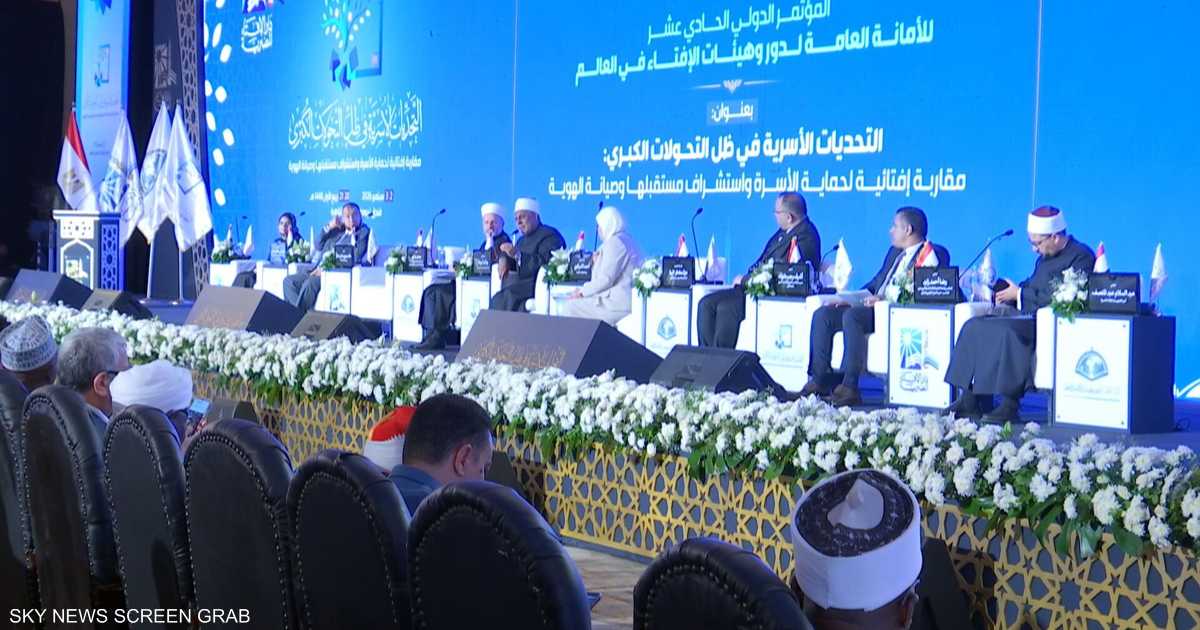
The General Secretariat of Fatwa Councils in the Muslim World unveiled two digital platforms at an international conference in Cairo: "Haseen," an AI-supported fatwa reference tool, and "Sakan," an interactive platform designed to support families and counter extremism in online environments.
Abdullah al-Najjar, a member of the Academy of Islamic Research and professor at Al-Azhar University, told Sky News Arabia that the success of these tools requires continuous monitoring and development to keep pace with accelerating technological change. Al-Najjar emphasized that artificial intelligence can assist Islamic jurists but cannot replace them.
Al-Najjar described family protection as one of the most pressing issues facing Islamic and Eastern societies, saying the family represents a "safety valve for society" and a means of preserving culture and transmitting it between generations. He linked the transmission of religious values across generations to the existence of a secure family environment.
He argued that protecting families now requires deploying cultural and humanitarian tools because the challenge affects humanity as a whole, not just a particular region or group. Al-Najjar noted that extremist organizations can reach young people in their homes without direct contact, exploiting isolation and weak family ties to spread ideas and expand recruitment.
On artificial intelligence's potential to replace human Islamic jurists, al-Najjar said the technology "will not replace the natural, knowledgeable jurist who understands religion and understands reality" and can correctly apply rulings to different situations. He cautioned that AI has a dual nature: it can provide useful solutions but also transmit ideas carrying dangers that religious authorities might struggle to counter.
Al-Najjar stressed that working with artificial intelligence requires monitoring, oversight, and adaptation because it continuously develops and presents new tools and ideas at an accelerating pace. He said using AI must be paired with critical thinking and protecting human values from its risks, accepting its use where beneficial while opposing it when it harms families.