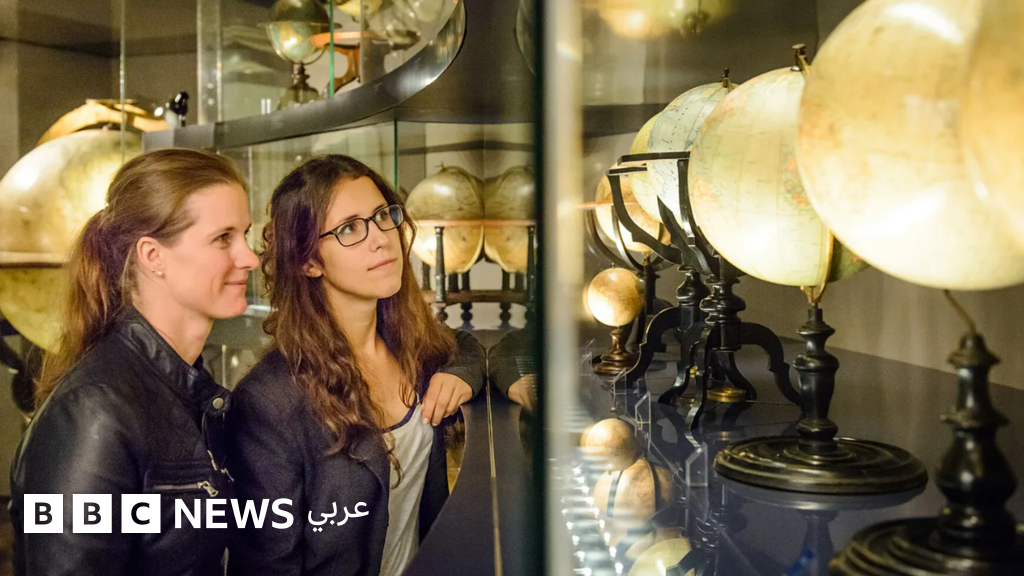
The Globe Museum in Vienna, located in the 17th-century Palais Mollard near Austria's National Library, is the world's only public museum dedicated entirely to globes. The collection contains more than 220 rare and antique globes, most dating before 1850, ranging from massive spheres made by Italian cartographer Vincenzo Coronelli to pocket-sized folding globes.
The museum opened with a room called the "Golden Cabinet," decorated with centuries-old frescoes depicting scenes from Greek mythology and displaying astronomical and geographical instruments including models showing Earth's orbit around the sun. Four silent main galleries follow, lined with glass display cabinets.
Among the collection's most striking pieces are two globes from the mid-16th century—one terrestrial and one celestial—made by the same craftsman roughly ten years apart. The terrestrial globe depicts Europe, the Mediterranean and African coasts with known names, while North America fades into unexplored polar regions, Asia appears distorted, and a imaginary southern continent replaces Australia and Antarctica. Sea monsters populate the Pacific in areas where known islands actually exist.
As visitors move through the collection, the globes reveal not merely what people knew but what they believed and imagined. Some globes show dragons and sea monsters in unexplored regions; others depict California as an island, a geographic misconception that persisted for a period. Several pieces carry marks of the colonial worldview of their era, including stereotypical and demeaning depictions of indigenous peoples and Spanish and Portuguese flags on sections of African coast.
A lunar globe from 1961 illustrates how geographic knowledge changed. The visible side of the moon was mapped precisely while the far side was left blank because humans had not yet seen it. Two years later, after the far side was explored, a new version added the newly discovered territory.
Martin Behaim's globe of 1492—made the same year Christopher Columbus sailed west—shows a world without the Americas, with only ocean stretching between Europe and Asia. Over time, globes evolved from luxury items owned only by nobility and wealthy merchants into smaller, cheaper objects that entered schools and homes as children's toys.