The weak equivalence principle, a cornerstone of Einstein's general relativity, holds that gravity accelerates all objects equally regardless of their composition. For the first time, a team led by Ming-Sheng Zhan at the Wuhan Institute of Physics and Mathematics has tested this principle using clouds of continuously free-falling atoms aboard an orbiting space station. The research was published in Science Advances.
The principle unifies two concepts that appear distinct: gravitational mass, which determines how strongly gravity pulls on an object, and inertial mass, which determines how much an object resists an applied force. If the two are truly equivalent, they cancel out entirely in equations of motion, meaning every object falls identically. Physicists have subjected this idea to increasingly rigorous experimental tests over more than a century, with Earth-based experiments reaching precision levels of 1 part in 10 trillion.
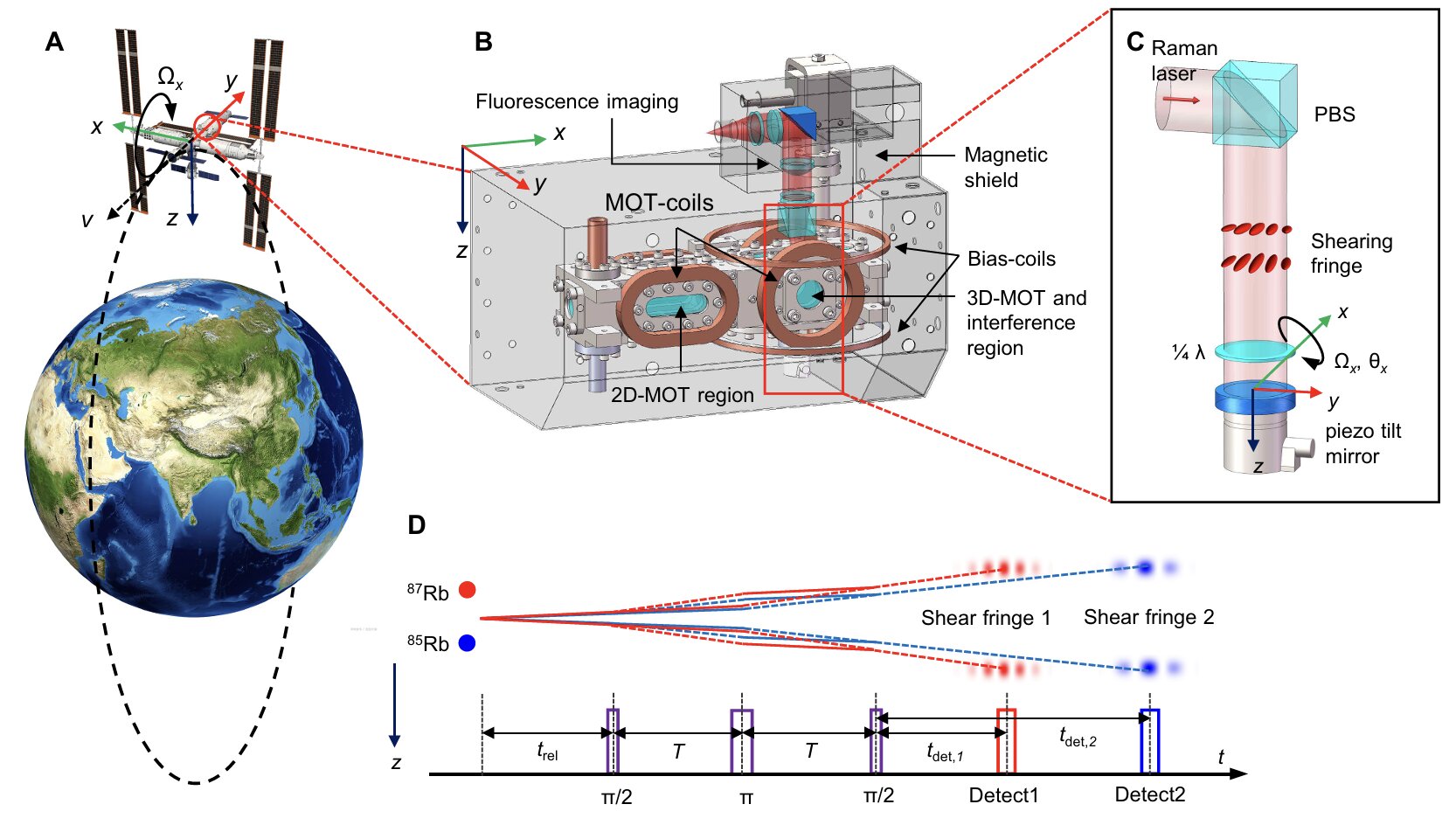
Zhan's team conducted their tests aboard the China Space Station, where the orbital path creates a state of permanent free fall for carried objects. They cooled two isotopes of rubidium to near absolute zero, then allowed both clouds to fall freely within specialized chambers. Using laser pulses, the researchers split each cloud into a superposition of two paths before recombining them, allowing them to measure each isotope's acceleration with exceptional sensitivity.
After collecting data over 280 days in orbit, the two rubidium isotopes were found to accelerate identically to within about 5 parts in 100 million—roughly three orders of magnitude more precise than any previous atom-based test conducted in microgravity. The results again validated the central assumption of Einstein's general relativity. Many physicists suspect that the equivalence principle could break down at quantum scales, potentially offering evidence for a theory unifying general relativity with quantum mechanics.
The team said future missions with longer free-fall times and more sensitive detection could push precision even further. Achieving those goals could help physicists identify scales where dark matter, quantum gravity and other exotic effects might leave detectable signatures.