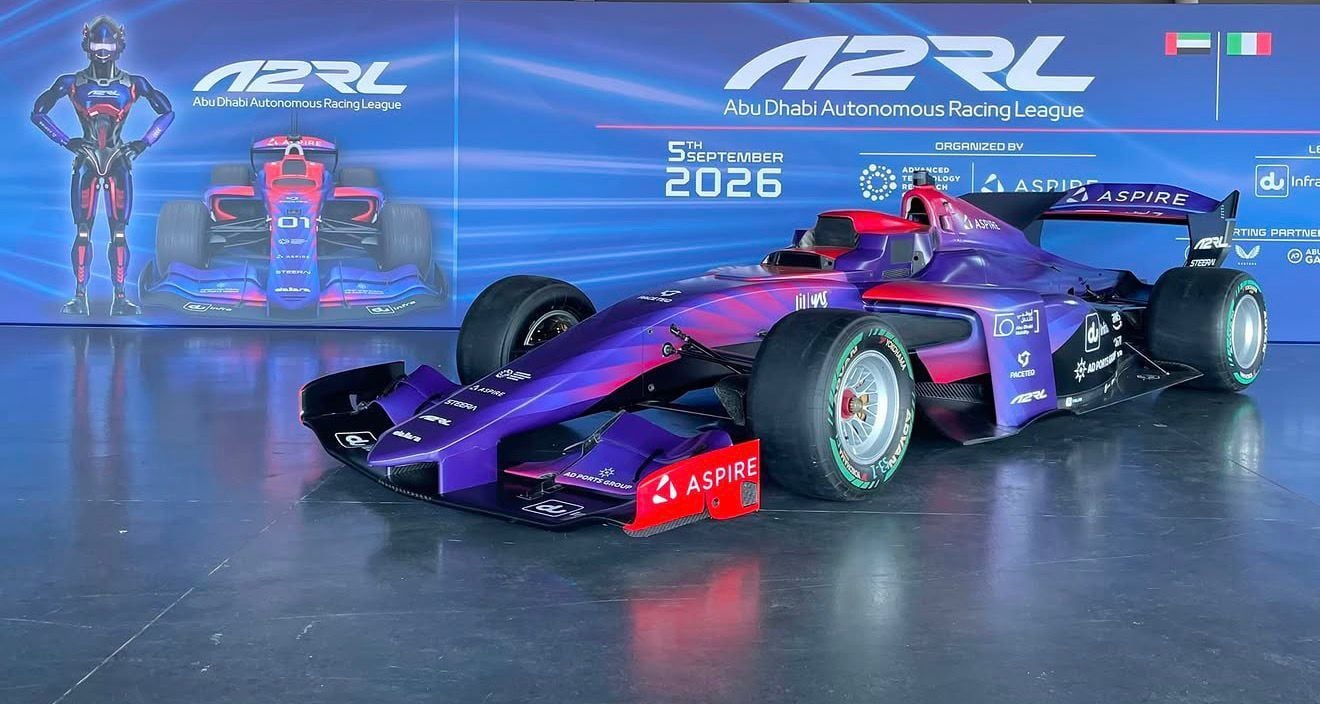
The UAE's Kinetiz won the Abu Dhabi Autonomous Racing League's first international race on Saturday at the Autodromo Internazionale Enzo e Dino Ferrari near Imola, Italy, with its autonomous Sparkz car finishing 10.963 seconds ahead of Germany's Constructor Racing. Italy's Unimore Racing placed third and fellow Italian team PoliMOVE fourth, after their vehicles collided during the 12-lap race, while Germany's TUM completed the five-team field.
The teams raced in autonomous versions of the Dallara Super Formula SF23, a car capable of exceeding 250 kilometres per hour. The event marked A2RL's first competition outside Abu Dhabi's Yas Marina Circuit, where the league had operated for two years.
Raffaele Giammaria, director of operations at ACI Sport, the governing body organizing the event, said the autonomous cars impressed observers unfamiliar with the technology. "If you tell someone that there is no driver inside the car, I think it is difficult to realise," he told The National, a regional outlet.
Michael Sonderby, chief executive of Abu Dhabi-based autonomous mobility company SteerAI, said decision-making remained the central challenge for racing systems operating at such speeds. "There are still certain situations where an error can happen. It's really the speed at which the decision-making needs to take all the inputs and process that into actions," he said.
Giammaria, who heads the Scuola Federale, Italy's federation racing school, said the school's training and research department is now studying how autonomous systems approach corners and manage throttle and braking to identify lessons for human drivers. SteerAI helped develop the original autonomy technology used by A2RL but the two projects have since diverged, with A2RL pursuing high-speed racing while SteerAI focuses on autonomous vehicles for off-road environments.
Sonderby said the collision during the race underscored remaining technical challenges as autonomous cars competed wheel-to-wheel. He added that racing applications could eventually support broader autonomous use in dangerous environments, citing discussions with energy producers about moving explosives and chemicals without human operators.